The future belongs to creators — not just consumers of technology. Across the world, students are no longer satisfied with simply learning theories from textbooks. They want to build robots, design intelligent systems, and solve real problems using Artificial Intelligence and robotics. This shift has transformed STEM education, making hands-on innovation more important than ever.
At the centre of this transformation is Quarky, an AI-enabled robotics board developed by STEMpedia. While many view Quarky as a classroom learning device, those who explore its capabilities quickly realize it is much more. It is a powerful robotics board that enables students to design AI-based projects, compete in global robotics competitions, and build solutions that address real-world challenges.
Quarky is not just about learning to code — it is about learning to innovate.
What is Quarky?
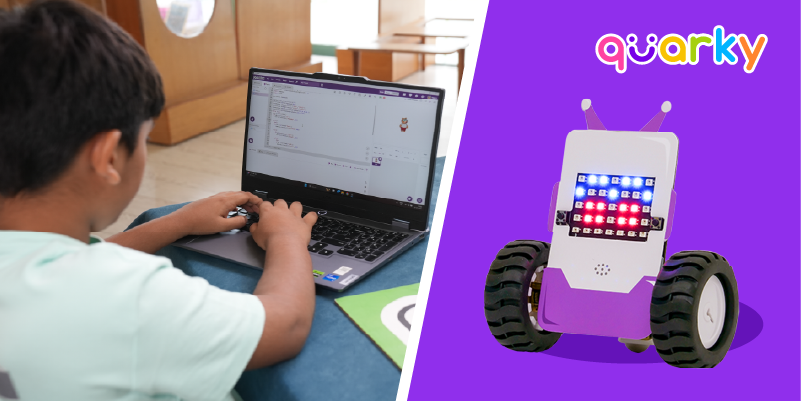
Quarky is an advanced programmable robotics board designed to introduce students to Artificial Intelligence, robotics, and IoT in a practical and engaging way. Unlike basic microcontroller boards, Quarky is built specifically for AI education and STEM learning.
It features a 7×5 RGB LED matrix display that allows expressive visual output, built-in sensors like touch and infrared for interaction, a speaker for audio feedback, and dedicated motor ports for robotics applications. With Wi-Fi and Bluetooth connectivity, Quarky supports wireless control and IoT-based systems.
One of its biggest strengths is its dual programming support. Beginners can use block-based coding to understand logic visually, while advanced learners can switch to Python programming for deeper control. This flexibility ensures that Quarky grows with the learner — from their first coding experiment to complex AI-driven robotics projects.
Quarky’s Full Potential and Capabilities
What makes Quarky stand out in the world of robotics boards is its ability to combine hardware control with artificial intelligence.
On the robotics side, Quarky can control DC motors, servo motors, and integrate multiple sensors. Students can build line-following robots, obstacle-avoiding bots, robotic arms, and autonomous vehicles. Quarky processes sensor inputs in real time, allowing robots to react intelligently to their surroundings.
On the AI front, Quarky supports projects involving face detection, image classification, object recognition, and decision-based automation when integrated with AI tools. Students can design systems that “see,” “analyze,” and “respond.”
With IoT capabilities, Quarky can also transmit data wirelessly, enabling smart dashboards, remote monitoring systems, and cloud-connected devices. This makes it suitable not only for school labs but also for real-world prototype development.
Quarky bridges AI, robotics, and IoT into one cohesive learning experience.
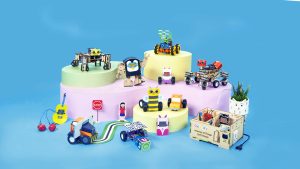
Quarky is Not Only for the Classroom
Although Quarky is widely adopted in schools for STEM education, its potential extends far beyond structured lessons. Quarky is powerful enough to serve as the brain of advanced robotic systems.
Students have used Quarky to design autonomous delivery robots, AI-powered assistants, smart agriculture systems, and intelligent surveillance prototypes. Its expandable design allows integration with additional modules, giving young innovators the freedom to experiment.
When students move from guided classroom tasks to open-ended innovation, Quarky does not limit them — it empowers them. It encourages problem-solving, critical thinking, and engineering creativity, which are essential skills for the future.
Great Projects Used in Robotics and AI Competitions
In robotics competitions, judges look for originality, technical depth, and social impact. Quarky has powered several impressive student projects in AI and robotics competitions.
For example, a team of middle school students built an AI-based waste segregation robot that could identify recyclable and non-recyclable materials using image recognition logic. Another group created a smart traffic management prototype that adjusted signal timing based on simulated vehicle density.
These projects were not just demonstrations — they were working systems built using Quarky’s motor control, sensor integration, and intelligent programming capabilities. Such real-world robotics projects show how students can move from learning concepts to applying them in meaningful ways.
NeuroFlex
Quarky Used in WSRO
The World STEM & Robotics Olympiad (WSRO) challenges students to design robots that address global themes like sustainability, disaster response, and smart cities.
Teams using Quarky have successfully built autonomous robots capable of navigating obstacle courses, performing object collection tasks, and responding dynamically to environmental conditions. Because Quarky supports real-time sensor feedback and programmable automation, it provides the reliability required in competitive environments.
In one WSRO regional event, a student team built a disaster-response robot prototype using Quarky that could detect obstacles and simulate victim identification. Their project received recognition for its innovation and technical execution — proving that a classroom device can also compete on an international stage.
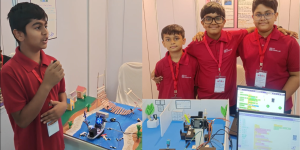
Quarky Used in Codeavour
Codeavour is a global AI competition that encourages students to develop technology solutions aligned with the UN Sustainable Development Goals.
Quarky plays a valuable role here by enabling students to create AI-based prototypes with real-world relevance. In past competitions, students have used Quarky to design:
Agrish Bot
Roadguard
One notable student project involved building a smart flood alert system using Quarky. The system detected rising water levels and triggered alerts, demonstrating how robotics and AI can contribute to community safety. Projects like these highlight how Quarky supports innovation with purpose.
Quarky Real-Life Problem Solving Projects
Beyond competitions, Quarky empowers students to address everyday challenges. From smart farming automation to energy monitoring systems, it provides the hardware foundation for impactful innovation.
Students have built prototypes that help Visually impaired People and Helping Women in their Menstrual Health. These projects reflect a deeper understanding of technology — not as a subject, but as a tool to improve lives.
This real-world problem-solving approach makes Quarky a powerful board for experiential learning and applied AI education.
Visually I am Paired
Womenstrual Cycle
Quarky Winning and Innovative Projects
Innovation thrives when students are given the right tools. Quarky has enabled numerous award-winning and high-recognition projects in robotics and AI competitions.
Winning projects often combine intelligent automation with strong engineering design. With Quarky, students can integrate multiple systems — sensors, motors, logic algorithms, and wireless communication — into one cohesive prototype.
What makes these projects stand out is not just the hardware, but the mindset it encourages. Students learn to think like innovators, engineers, and problem-solvers. They gain confidence in presenting technical solutions and competing at higher levels.
Carbon Capture Unit
Conclusion: A Board That Builds Innovators
Quarky is far more than a classroom robotics board. It is a gateway to Artificial Intelligence education, robotics competitions, and real-world problem-solving. From building their first line-following robot to presenting AI-driven prototypes at global competitions like WSRO and Codeavour, students grow with Quarky at every stage.